


A nation without newborns - South Korea's silent crisis
Current situation
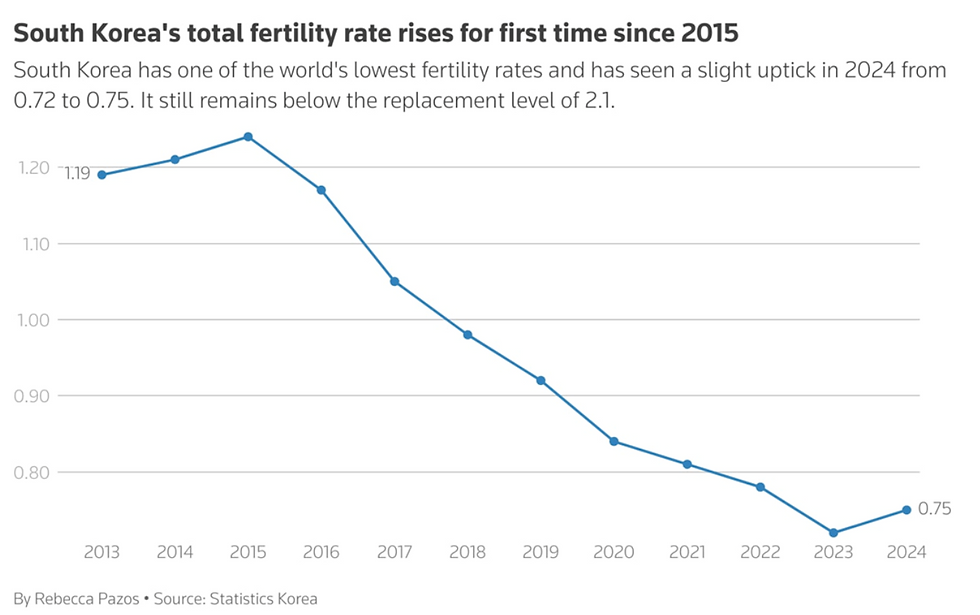
South Korea has had the lowest birth rate ever recorded on our planet, with only 0.72 children being born per household back in 2023 (the rate would need to be 2.1 in order for the replacement level to be met). According to the South Korean Ministry of Data and Statistics, in the past 2 years, this number has improved for the first time in decades, going up to 0.75 in 2024 (see table below), and as of 2025, the fertility rate has increased to 0.80 children per household. Despite slight recent improvements, South Korea is undoubtedly still facing a crisis since the population is constantly shrinking. In 2025, there were about 225 thousand babies born, meanwhile there were 363 thousand deaths reported– this means that as of last year, the population was in a 138 thousand decline. This trend has been noticed over the past few years (KOSTAT 2026). Declining fertility rates are common in most of the Global North, but what is actually causing such dramatic, never-before-seen record numbers in this one country?
The price of starting a family
One of the main reasons the South Korean people are not having children is because of how expensive life has become.Many South Koreans have ambitions to live in Seoul or in the Seoul metropolitan area, which is where all the most prestigious schools, universities, and job offers are. An ordinary citizen in Seoul is barely able to make ends meet themselves, let alone provide for another human being.
The reason as to why it is so expensive to live in Seoul is due to how densely populated the capital city is. 26 million Koreans live in the Seoul Metropolitan area (see figure below), which makes up for over half of the South Korean Population (51.6 million as of early 2026). An OECD report says that housing prices are incredibly high, schools are competitive, increasing the financial burden on young people, therefore it is simply unrealistic for a Korean with an average salary to provide for a family.

As of late 2025, the number of single-person households has surpassed 10 million, making up for about 42% of all households in the country (data from the Ministry of Interior and Safety). Such houses are not fit to start a family, since, according to Korean social standards, owning a house is seen as a prerequisite to marriage and having children. If someone were to be interested in buying a house, this task is simply impossible for a citizen with an average salary, as the PIR (Price to Income Ratio) stands at about 13.9 as of late 2025, according to the Korea Herald. This means that it would take the average Korean around 14 years of saving their entire salary without spending a single won, in order to afford housing in the capital city.
Work culture
The South Korean tradition is based on Confucianism and collectivism, which leads to a hierarchical work culture. This further leads to expectations of having to prioritize social life and the work team. Often, dinners with your bosses and co-workers are expected, and implied to be mandatory. If somebody chooses to prioritize themselves, take time off or simply spend their time differently, they are seen as selfish, which further leads to exclusion and discrimination in the work place. Such career habits make it really hard to maintain a private life, let alone start and take care of a family. South Korea's work culture is one of the most competitive and demanding in the world, and since citizens tend to be very career-driven, there is no room for considering starting a family.
Not to mention, South Korea has one of the longest working hours among OECD nations, averaging roughly 1901 hours per year. Despite the legal standard being 40 work hours a week, a maximum of 12 hours overtime is allowed, which adds up to 52 hours of work per week. The number of work hours keeps rising with time, due to growing expectations (see table below).

Such a competitive society is even reflected in the lives of children. It is expected that parents will send their kids to academies, provide good tutoring, all of which is really expensive. Now, a parent could opt out of these extra activities, since it causes intense pressure on the child .However, they are seen as practically mandatory in society. They are an important part of children’s social life that they would be missing out on– just as in school, they use such spaces to bond and socialize. Such expectations can be very constraining for children, but on the other hand, the parents do not want the children to feel left out.
Lifestyle
Most South Koreans, especially younger generations, are increasingly choosing not to have children. Aware of the almost impossible standards in order to start a family, a lot of people simply do not consider having kids as one of their life goals. Instead, they choose to spend money on themselves, focus on work, and go travelling, because they cannot afford a house or the kind of stable life needed to raise a family.
Multiple locations in South Korea have put up ‘Child-free zones’ (see picture below) with hundreds of cafes, restaurants, and private establishments prohibiting children in order to ensure silence, safety, and avoid property damage. There is much negativity around children in society in general, with expressions such as ‘being childless is a blessing’ surfacing around and being commonly used.

Because of the career-driven society, people spend most of their twenties and early thirties focused on their careers. The average age of marriage is higher, because people first need to build stability. There is quite intense pressure to meet societal standards before getting married.
The procedure for getting married, from a societal point of view, can be quite strict. Couples often need to have approval from those around them, especially families and parents. This includes mandatory meetings between the two families and background checks in order to make sure a person is a fit candidate for the marriage of the son or daughter. A lot of people simply do not want to go through these processes anymore, while those around them still expect them to fit into such traditions.
Societal expectations and gender roles
There is a double burden placed on mothers. In South Korea, it is still mostly believed that women should be the ones taking care of the children. Such expectations put a lot of pressure on the mothers. After having a child, the strict work expectations do not disappear, and having to take care of children simultaneously is nearly impossible. If a woman chooses to prioritize her child and take time off work for those reasons, she is seen as selfish, however if she prioritizes her work, she is then portrayed as a bad mother.
Both men and women have an opportunity to take up to a year's leave in the first 8 years of their child's life. According to the BBC, in 2022, only 6.8% of new fathers have used their parental leave, compared to 70% of new mothers, further highlighting the gender gap in childbearing responsibilities. Such statistics can also be noticed in the table below by the Ministry of Employment and Labor. It shows that Korean workplace culture still expects fathers to prioritize work over childcare, which places the burden of care almost entirely on mothers. After taking maternity leave, workers are often forced to leave their jobs or are passed over for promotions.

Another factor that makes it especially harder for younger people to start families is mandatory military service. Young men between the ages of 18 and 28 are forced to serve in the military for 18 to 21 months. Since men of those ages are usually away, it makes it harder for people to start traditional families. Men have no way of making a stable income, and even if they were to have kids before their service, it would then later leave the mothers alone, putting even more responsibility on women with no one to help raise the child.
Due to the societal pressures, when women do start thinking about starting a family and having children, they tend to be much older than the global average of having children, which is approximately 28, meanwhile in South Korea, it is almost 34. Due to age, certain health complications arise, so women are often forced to resort to in vitro fertilization, which is very physically, mentally, and financially draining.
What is being done?
The South Korean government has been trying to address the birth rate crisis in multiple ways. Since 2006, the government has spent over 360 trillion won on this issue. There have been financial incentives with increased monthly payments to households with infants, housing tax and assistance with special housing support and monthly cash allowances for parents. The government has also subsidized up to 1.1 million won for each IVF treatment, but despite the support, many patients still face very high costs and workplace challenges when taking leave for treatment.
There have also been multiple dating support programs introduced. Korean people are often just not interested in dating. To aid this issue, the dating and wedding culture has been sponsored by the Korean government, by encouraging people to go on blind or ordinary dates, and providing financial support. Marriages in public parks or museums, and reduced rent of 10 thousand won per month (Korea.net) for a new home after marriage, are just a few attempts to encourage the South Korean population to date and marry.
Despite the government's efforts, the South Korean population is continuing with its work-centered lifestyle. These policies have only had limited success so far, suggesting that a different approach is necessary. According to Sarah Barnes: ‘Policies focused on gender equality and improving women's lives with education and employment would fare better than pro-natalist efforts.’
To simply put it, the South Korean living standards and expectations simply have no space for families or children. Most South Koreans are focused on their careers and social status, and even if one were to have such plans, it is almost impossible to afford good housing and opportunities for the family. Meanwhile, Koreans have to struggle with up-keeping the societal image, without being left behind by the competitive work force. Not to mention the unattainable expectations for women, having to be a good mom and member of society at once. The current Korean system is not built for having children, and if this crisis were to be resolved, it is not only the government's efforts, but those of society that are important.
Bibliography:
BBC (2024) South Korea’s population crisis explained. Available at: https://www.bbc.com/news/world-asia-68402139
Heinrich Böll Foundation (2023) Population control, reproductive rights and feminist perspectives on low fertility rates in South Korea. Available at: https://kr.boell.org/en/2023/05/24/population-control-reproductive-rights-feminist-perspectives-low-fertility-rates-south
Jung, J., (2024) When massified higher education meets shrinking birth rates: the case of South Korea. Higher Education, 88(6), pp.2357-2373. Available at: https://link.springer.com/article/10.1007/s10734-024-01220-2
Kim, C.Y. and Chung, S.H., (2024) Demographic transition in South Korea: implications of falling birth rates. Clinical and Experimental Pediatrics, 67(10), p.498. Available at: https://pmc.ncbi.nlm.nih.gov/articles/PMC11471922/
Korea Herald (2024) Average Korean worker needs 14 years of full salary to buy home. Available at: https://www.koreaherald.com/article/10617553
Korea Herald (2024) Rise of one-person households in South Korea. Available at: https://www.koreaherald.com/article/10563104
Korea.net (2024) Gov’t provides aid for dating and marriage. Available at: https://www.korea.net/NewsFocus/Society/view?articleId=257194
OECD (2025) Korea’s unborn future: Understanding low-fertility trends – When family aspirations clash with realities of life: Underlying causes of low fertility. Paris: OECD Publishing. Available at: https://www.oecd.org/en/publications/korea-s-unborn-future_005ce8f7-en/full-report/when-family-aspirations-clash-with-realities-of-life-underlying-causes-of-low-fertility_2193bc37.html?
The Business Times (2026) South Korea’s baby bump extends second year, offering hope. Available at: https://www.businesstimes.com.sg/international/south-koreas-baby-bump-extends-second-year-offering-hope
The Guardian (2026) South Korea birth rate increase: rise echoes ‘boomers’. Available at: https://www.theguardian.com/world/2026/feb/25/south-korea-birth-rate-increase-rise-echo-boomers
Think Global Health (n.d.) South Korea’s plan to avoid population collapse. Available at: https://www.thinkglobalhealth.org/article/south-koreas-plan-avoid-population-collapse


Comments