


Language is the Philippines’ Longest Colonizer
The Philippines is a country of vibrant diversity – from its green plains, to its coral reefs, to its islands and their traditions, to their different tribal groups, it is a country that serves as a melting pot to all its residents, and there is not a clearer representation of this than the over 180 dialects and 8 languages spoken, with the most commonly used being Tagalog according to the Department of Foreign Affairs (2024). However, the Philippines is currently facing a silent crisis: linguistic diversity is in decline. With the rise of globalization and the country’s economic dependence on international actors, the effects are becoming increasingly apparent; and Filipino is not considered a dying language, it is being used less and less among younger generations. However, it could be argued that this evolution is not merely an effect of recent developments, but a continuation of colonialism through Spanish, Japanese, and American colonizers and is further perpetuated by the Filipino education system that prioritizes English, not Filipino, as the standard language of teaching. Language has become a tool of internal colonialism that has continued to alienate the Filipino people from their unique linguistic heritage.

When talking about the fragmentation of the Filipino language, it cannot be separated from the colonial powers that used language as a tool of control over the country and its people. Before it was colonized, the Philippines was not a stranger to engaging with foreign cultures. It is known to have had trade relationships with China since the 13th century, according to Clemente, T.S. (2012), and with Arab and Indian merchants for over a thousand years. However, it was the Spanish colonization that took the country by storm and played the earliest and most defining role in reshaping indigenous cultures. Not only did they create ‘Las Islas Filipinas’ that essentially combined different tribes into one colony, but they also transplanted Spanish economics, culture, religion, and to an extent, even identity to the people. Spanish rule enforced that once pagan tribes converted to Catholicism, they privatized land and even went so far as to create a book, the Catálogo alfabético de apellidos (Alphabetical Catalogue of Surnames), that mandated that traditional Filipino surnames be changed to standardized Spanish ones under the Claveria Decree in 1849.
Spanish Colonization (1565-1898)
Even in the earliest days of colonization, language has already been a tool of control. Tagalog was seen to be the cause of the Filipino’s backwardness. Patricio de la Escosura, who had been sent as
King’s Commissar to the Philippines to investigate problems on the ground writes: “as long as the Indian continues to use his primitive language, it will be next to impossible for him to shake off entirely the concerns, superstition, false beliefs and childishness that typify the savage state” (Escosura 1882: 6). On the other hand, Spanish was deemed as the language of the elite, and after three hundred and fifty years of Spanish occupation, less than 10 per cent of the population spoke Spanish, as mentioned in Fernandez, M. (2013).

Nevertheless, it became the official language of government, law, and higher education, thereby distinguishing the educated, called the Ilustrados, from the common folk. Henry Jones Ford, a Princeton professor who had been sent to the Philippines on a ‘Fact-finding mission’ by then President Woodrow Wilson, notes: “the Filipino gentry speak Spanish, and the masses speak native dialects which are not low languages, but are refined and capable instruments of thought” (1916: 213–14). We can see that from the very start of the Philippines’ inception, language has been a tool that caused division within society, and the local tongue was relegated almost exclusively to the domestic sphere, and even resulted in the extinction of the Philippines’ unique alphabet called Baybayin due to the enforcement of the usage of Latin text brought by the Spaniards, according to Esquire Philippines (2017).

American Colonization (1898-1946)
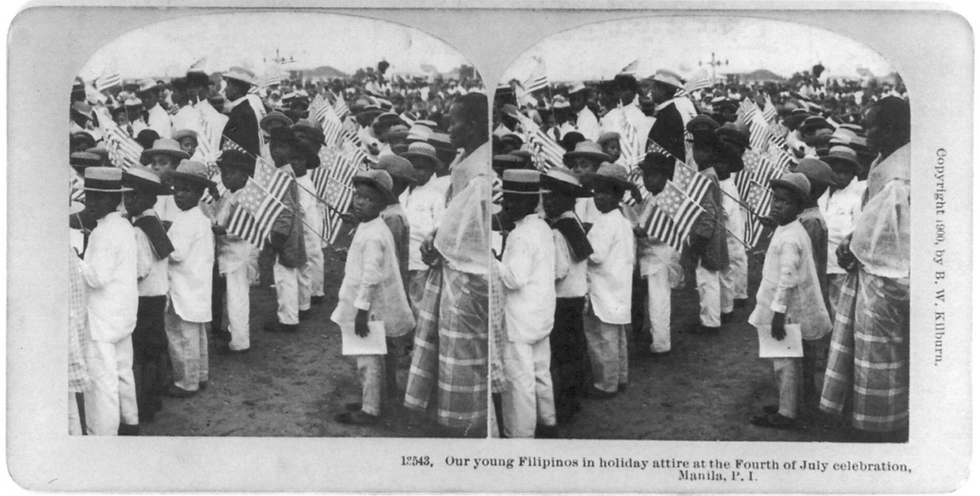
This pattern was further upheld with the arrival of American rule. In 1898, the United States essentially purchased the Philippines from Spain for $20 million, according to the U.S. Department of State. This led to the decline of Spanish as the language of the elite and to the introduction of English as the sole medium of instruction. Then, American President McKinley's policy towards the Philippines was "benevolent assimilation," aimed at annexing the archipelago to "uplift, civilize, and Christianize" the Filipino people following the 1898 Spanish-American War, according to Mukharji, A. (2023). English became the language of democracy and modernity. It was used in education, with the United States implementing a language assimilation policy, which entailed promoting English in the Philippines and instituting English education for all (Sibayan and Gonzalez, 2011), and through Christian ministry, leading the Philippines to become one of the world’s largest English-speaking countries, according to EF Education First, (2025).


Japanese Colonization (1941-1945)
As the latest power to colonize the Philippines, Japan did not play as big a role in perpetuating language hierarchies among the people. During its short but arguably gruesome period of control, it tried to implement a policy of ‘Japanisation’ in education, according to Gosiengfiao, V. (1966). However, the country did not have ideological control over the Filipino people, and so attempts such as these were met with resistance and even the fortification of Filipino identity. This, however, shows how quickly linguistic policies shift and change to accommodate different rule.
Role of the Government
Centuries of colonization laid the foundation for the Philippines’ long-standing silent battle over its linguistic identity, and its effects persist even after 80 years of freedom. The question stands: Who is maintaining this system? It is arguably none other than the independent Philippine government itself through the education system. In a pivotal 2018 ruling by the Filipino Supreme Court, Filipino was removed as a core subject in college under the new General Education Curriculum, aiming to reduce the number of courses to make way for specialized studies. Filipino and Panitikan activists argue that this prioritizes English over Filipino and Panitikan, noting that English instruction is still required in college. It said this violates the Constitution, which mandates Filipino as the primary official language and English as “merely a secondary language.” It adds that the Constitution itself provides that English’s status as an official language may even be removed by law (Navallo, M. (2019).
It is decisions like these, made by those in control, that shape people’s perception of our native tongue. Growing up in the Philippines, people did not hide their view of Filipino as being ‘less than’ compared to English. In a class made of purely Filipino children born and raised in the Philippines, there would always be a handful of kids who did not speak Filipino at all, and were met with praise and accommodation from teachers and adults. Speaking only English was, more often than not, a sign of intellect as well as class. ‘Engliseros’ or English speakers are put on a pedestal of superiority, while those who do not speak English or speak it very poorly are labeled as ‘Barok’, coined from a caveman-like character from a 1970s comic strip, signifying that non-English speakers are ‘primitive’, as mentioned in Cervantes, C. L. (2025). This creates generations of Filipinos who learn that societal validation and being labeled as ‘smart’ come at the cost of abandoning their mother tongue.
Seeds of hope for the future
However, the case of this problem is not without hope. Filipino voices are still being heard and upheld in various ways. According to Lamentillo, A. M. Y. (2025, author and Karay-a native Anna Mae Lamentillo, points to bilingual education programs in Mindanao that use local languages in early-grade instruction, which have been shown to improve literacy and cultural connection. Additionally, she adds that digital platforms are also becoming tools for propagating linguistic diversity, such as Aeta language podcasts, mangyan vocabulary apps, and Ilocano music channels, which play a big role in preserving ethnic tongues in modern spaces.
From its inception, language has been a weapon of control for the Filipino people. Through colonization, we have lost integral parts of our unique culture and identity, been subjected to ideological control, and lost ancient religions practiced by our ancestors. Today, through the Filipino government’s policies and lack of action in upholding the value of the Filipino language, we as people have remained unable to break through the glass ceiling that our colonizers kept us in. By implementing educational programs that do not prioritize Filipino and by maintaining English as the baseline of success, the Filipino language as a whole is at risk of extinction. We must move forward and decolonize our thinking, starting in the classroom, supporting community-led initiatives, and using technology to uphold and safeguard our linguistic heritage.
Bibliography
Schwartz, K., 1971. Filipino education and Spanish colonialism: Toward an autonomous perspective. Comparative Education Review, 15(2), pp.202-218.
Clemente, T.S. (2012) 'Chinese trade in pre-Spanish Philippines: credit, hostage and raid regimes', Jati, 17, pp. 191-206.
Lopez, E. (2021) 'Decolonising the Philippine language: The ebb and flow of Spanish influence on Filipino culture', Decolonising Modern Languages and Cultures, 10 May. Available at: https://blogs.ncl.ac.uk/decolonisesml/tag/the-philippines/
Narciso Claveria 1849 decree and the surnames of the people of Lipa' (2019) Batangas History, 22 February. Available at: https://www.batangashistory.date/2019/02/narciso-claverias-1849-decree-and.html
U.S. Department of State, Office of the Historian The Spanish-American War, 1898. Available at: https://history.state.gov/milestones/1866-1898/spanish-american-war
Mukharji, A. (2023) 'The meddler's trap: McKinley, the Philippines, and the difficulty of letting go', International Security, 48(2), pp. 49–90. doi:10.1162/isec_a_00471.
Sibayan, B.P. and Gonzalez, A. (2011) Post-imperial English in the Philippines. Berlin: De Gruyter Mouton.
EF Education First (2025) Philippines | EF English Proficiency Index. Available at: https://www.ef.com/wwen/epi/regions/asia/philippines/
Esquire Philippines (2017) 'The life, death and resurgence of baybayin', 11 August.
Gosiengfiao, V. (1966) 'The Japanese Occupation: "The Cultural Campaign"', Philippine Studies, 14(2), pp. 228–242. doi:10.13185/2244-1638.2433.
Navallo, M. (2019, June 10). Removing Filipino in college to lead to 'cultural genocide' - group. ABS-CBN News. https://news.abs-cbn.com/
Cervantes, C. L. (2025). Learning the lingua franca—‘lingua franca?!’ InquirerPlus. Published August 23, 2025
Lamentillo, A. M. Y. (2025). Metro Manila’s Linguistic Paradox: A Melting Pot on the Brink. LSE Southeast Asia Blog. 21 July. Available at: https://blogs.lse.ac.uk/seac/2025/07/21/metro-manilas-linguistic-paradox-a-melting-pot-on-the-brink/


Comments