


The Great Complexes of the Little Man: A Psychological Profile of Vladimir Putin
The Genius Loci: The Mythology of Baskov Lane
To truly grasp the essence of Vladimir Putin, one must first understand the environment that forged him. Leningrad in the 1950s was no longer a city of imperial grandeur; it was a city of scars, steeped in the stench of decay and the lingering trauma of the Siege. Putin was born in 1952 into a family that embodied this collective agony. His father, Vladimir Spiridonovich, returned from the front a disabled veteran, while his mother, Maria Ivanovna, had narrowly escaped starvation during the blockade. The loss of his two older brothers — one dying in infancy, and the other, Viktor, succumbing to diphtheria during the Siege — cast a heavy shadow over the household. Vladimir became the "miracle child," the sole survivor in a family of ghosts. Psychologists often refer to this as "Replacement Child Syndrome." From a young age, "Volodya" was tacitly burdened with the mission of living for those who did not survive. Yet the reality surrounding him was far from sacred. Life in the communal flat on Baskov Lane was a claustrophobic existence — a world with no privacy, where the shared kitchen served as an arena for petty feuds, and the stairwells were territories governed by street gangs. It was in these corridors that his first life lesson took root: the doctrine of absolute mistrust. In a world where every square meter is a battlefield, sincerity is a liability. The famous anecdote of the cornered rat, which Putin himself recounts in First Person, serves as the psychological blueprint for his future "Red Lines" foreign policy. Witnessing a rodent, trapped and desperate, lunging at its pursuer’s face instead of surrendering, Putin internalized a chilling truth: when you are small and perceived as weak, your only hope lies in sudden, paralyzing aggression. This is not merely a childhood memory; it is the cornerstone of his behavior on the world stage today.

The School Years: The Invisibility Complex
In school photographs, Putin appears as something of an anomaly. While his peers strive to look taller or more significant, he seems to deliberately blend into the background. This reveals a vital psychological paradox: a thirst for power through inconspicuousness. His teachers remembered him as "sharp-tongued" and prone to conflict — a child who struggled for a long time to find his footing. His sense of "deprivation" was both material and physical. In a world dominated by fists, his small stature forced him to seek asymmetrical solutions. Sports became his first sanctioned outlet for violence. Tellingly, he did not choose boxing — where raw power reigns — but turned instead to Sambo and Judo. The philosophy of Judo — "softness overcomes strength" — was a perfect fit for his temperament. It is the art of waiting for an opponent to make a mistake, then using the momentum of their own weight to execute a throw. This "wrestler’s style" would later become his hallmark in backroom politics: he never engages in an open confrontation unless he is certain his opponent has already lost their balance.
The Temple of the System: Recruitment as Initiation
While most Soviet boys idolized cosmonauts or scientists, Putin’s gaze was fixed on the KGB. Through a psychoanalytical lens, this was a desperate reach for the "Superego." In the USSR, the KGB was an entity that existed above the law, above mundane reality, and far above the squalor of communal flats. At sixteen, he approached the "Big House" on Liteiny Prospekt with a singular question: how could he join? He was told he needed to either obtain a law degree or complete military service. With a near-maniacal resolve, he pursued that objective for years. Entering the security services was a psychological rebirth. Within the agency, he found the one thing the backstreets could never provide: institutional armor. The man in the grey suit, ID card tucked in his pocket, was no longer the frail boy from Baskov Lane; now, the crushing might of a nuclear superpower stood at his back. The KGB refined his most essential skill: mimicry. He was taught to "mirror" his interlocutor and to vanish into a crowd without ever betraying his inner self. This calculated "facelessness" would eventually become his greatest political asset.
Dresden: The Shattering of Illusions and the Fear of the Crowd
The most profound, yet often underrated, period of Putin’s life was his service in East Germany (1985–1990). To him, the GDR was a "perfected USSR" — a realm of absolute order, sterile cleanliness, and rigid discipline. He felt like a vital cog in a grand, invincible machine. But the events of 1989 systematically dismantled that reality. The fall of the Berlin Wall was not a liberation for Putin; it was a personal catastrophe. As an angry crowd surrounded the KGB villa in Dresden, Putin desperately telephoned the Soviet military command seeking protection. The response he received was chilling: "Moscow is silent." That phrase would become his lifelong nightmare. He stood witness as a sprawling empire disintegrated in a matter of days under the pressure of "the street," while the center — the very heart that was supposed to radiate authority — was paralyzed by its own indecision.

It was in Dresden that his visceral hatred of popular protest took root — a seed that would later grow into a full-scale paranoia regarding "color revolutions." To Putin, a crowd is not "the people"; it is a chaotic force that obliterates order. Since that day, his singular obsession has been the construction of a system where "Moscow will never fall silent," ensuring the state remains impenetrable and the authorities never find themselves defenseless before their own citizens.
Return to the Ruins: the St. Petersburg School of Survival
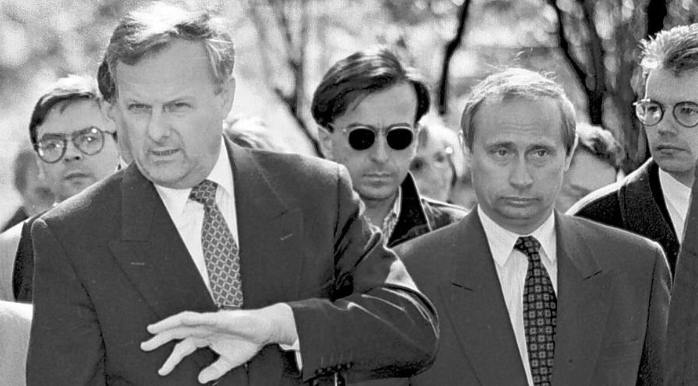
Upon returning to a Leningrad that would soon be renamed St. Petersburg, Putin emerged into a world where his former ideals had been unceremoniously trampled. The USSR had vanished, leaving its former KGB elite to scavenge for survival as taxi drivers or bodyguards for the nouveau riche. Putin, however, navigated a different path — evolving into a "fixer" within the democratic administration of Anatoly Sobchak. His tenure at the St. Petersburg City Hall in the 1990s served as a masterclass in cynicism. Amidst the lawless chaos of "wild capitalism," Putin learned to synthesize the clandestine methods of the secret services with raw commercial interests. Tasked with overseeing external relations and food supply licenses, he operated in the murky intersection of state power and private profit. It was here that the foundations of "Putinism" were laid: a dark fusion of security structures, criminal underworld tactics, and state-controlled capitalism.
At the time, he was dismissed as a mere "technical executor" — an efficient, loyal assistant who preferred the shadows. He was the man who carried Sobchak’s briefcase and stood silently behind him on the podium. No one — absolutely no one — suspected that this inconspicuous figure was a dictator in waiting. His perceived insignificance was, in fact, his perfect disguise.
The Leap into the Kremlin: Operation ‘Successor’
By 1999, Putin’s appointment as Boris Yeltsin’s heir appeared to many as a historical accident — a miscalculation by an elite searching for an unassuming, "convenient pawn." However, the oligarchs and power brokers of the era failed to grasp a critical truth: a man who had spent decades accumulating resources while concealing his ambitions behind a mask of diligence had no intention of being a mere placeholder. The transition from the director’s chair at the FSB to the presidency was his final move in a personal duel with fate, transforming the "technical candidate" into an absolute autocrat. His ascent was both rapid and manufactured. The Second Chechen War served as the grim forge in which the image of a "strong leader" was molded from that of a "gray bureaucrat." His infamous vow to "flush them down the toilet" was a direct echo of the street slang from his Leningrad youth. It was a calculated signal to the masses: "I am one of you; I have come to avenge our humiliations." Thus, the "little man" with his deep-seated complexes, forged in an environment of fear and deprivation, secured the nuclear briefcase. His rise was not a triumph of democracy, but a victory for revanchism. He came to power to prove to the world — and, perhaps more importantly, to himself — that the boy in the school photograph would never again be left standing on the sidelines.
Military Policy: the Export of Violence

The Second Chechen War (1999–2000) served as the first harrowing manifestation of Putin’s strategy: the forceful subjugation of a population under the guise of internal security. Russian forces, orchestrated by federal security services, launched a campaign of scorched-earth tactics, characterized by indiscriminate airstrikes, heavy artillery barrages, and the deliberate strangulation of civilian infrastructure. Grozny was effectively erased from the map; its residential districts, hospitals, and schools reduced to skeletal remains. Human rights organizations estimate the civilian death toll between 25,000 and 50,000, with more than 200,000 people transformed into internally displaced refugees. The sheer brutality of the conflict was epitomized by the infamous "cleansing operations" (зачистки) in villages like Alkhan-Yurt and Novye Aldy, where documented mass killings took place. Furthermore, the systematic use of extrajudicial executions, enforced disappearances, and the notorious "filtration camp" system — most notably the Chernokozovo facility — was designed to terrorize the populace into submission. International bodies, including Human Rights Watch and Amnesty International, have categorized these atrocities as war crimes and crimes against humanity. Ultimately, the Chechen conflict established the foundational "Putin Model": the consolidation of absolute power through state-sponsored violence, where the sanctity of human life is entirely discarded in favor of imperial control.
The conflict in Georgia in August 2008 marked a turning point: the first overt instance of Russian military aggression against a sovereign state since the collapse of the Soviet Union. While the official pretext was the "protection of Russian citizens" in South Ossetia — a crisis manufactured through a cynical "passportization" policy — the true objective was to reassert Moscow’s hegemony and derail Georgia’s aspirations toward NATO integration. Russian forces unleashed a campaign of massive artillery barrages, indiscriminate airstrikes, and ground incursions that pierced deep into Georgian territory. The cities of Tskhinvali and Gori bore the brunt of the assault; residential districts, schools, and hospitals were systematically devastated. International observers documented harrowing accounts of torture, extrajudicial executions, and the ethnic cleansing of Georgians in the enclaves surrounding Tskhinvali — atrocities carried out by local militias under the tacit protection of the Russian army. By unilaterally recognizing the independence of Abkhazia and South Ossetia, Moscow committed a flagrant violation of international law, specifically Article 2(4) of the UN Charter. This conflict served as a warning: under Putin’s leadership, Russia was prepared to discard international norms and resort to naked aggression to secure its strategic interests. It was the moment the world realized that for the Kremlin, sovereignty is merely an obstacle to be crushed.


The annexation of Crimea in 2014 and the subsequent full-scale invasion of Ukraine in 2022 represent the chilling culmination of Putin’s military doctrine. The Crimean "referendum" was a hollow theatrical performance conducted at gunpoint by Russian special operations forces — the infamous "little green men." Carried out in the absence of international observers and under direct duress, the annexation flagrantly violated the UN Charter, the Budapest Memorandum, and Russia’s own treaty obligations regarding Ukraine’s territorial integrity. By 2022, the "hybrid" warfare of the Donbas evolved into a total war that took on the distinct characteristics of genocide. The siege of Mariupol became a modern-day tragedy, where thousands were entombed beneath the rubble of their own homes — most notably in the Drama Theater, which was struck despite the desperate warning "CHILDREN" inscribed in large letters outside. The systematic use of prohibited weaponry, such as cluster and phosphorus munitions, alongside relentless missile strikes on civilian hubs and the deliberate obstruction of humanitarian aid, became the standard of Russian engagement. In just the first six months of the invasion, over four million Ukrainians were forced into exile, with the death toll climbing into the tens of thousands.
The atrocities uncovered in the wake of the Russian retreat — the massacre in Bucha and the torture chambers of Izium — bear witness to a calculated policy of eliminating Ukrainian identity. These atrocities are not merely collateral damage; under the Rome Statute of the ICC, they are documented war crimes and acts of state-sponsored aggression. Ukraine has become the ultimate evidence of Putin’s worldview: a reality where the sovereignty of others is an illusion, and violence is the only legitimate currency of power.
Ultimately, the scorched earth of Chechnya, the fractured sovereignty of Georgia, and the decimated cities of Ukraine are not isolated tragedies. Together, they illustrate a chillingly consistent pattern in Russian military policy under Putin’s leadership: a fusion of unrestrained violence, a wholesale disregard for international law, and the ruthless application of force to bolster domestic and geopolitical standing. Each of these interventions reveals a calculated strategy aimed at securing strategic objectives at any cost. In Putin’s worldview, the sanctity of international obligations and the lives of millions are merely secondary to the pursuit of power — a pursuit that has transformed Russia into a state whose primary export is destabilization and whose primary language is aggression.
The Practice of Political Assassination

Anna Politkovskaya was a journalist and author renowned for her unflinching and principled criticism of the Russian state, particularly its conduct in Chechnya. Joining Novaya Gazeta in 1999 at the dawn of the Second Chechen War, she dedicated her career to exposing human rights violations, war crimes, and the systemic abuses perpetrated by the security services. Her reports meticulously documented torture, enforced disappearances, and extrajudicial executions, providing a harrowing account of how federal forces operated in total defiance of both Russian law and international standards. Her murder in October 2006 — shot point-blank in the elevator of her Moscow apartment building — was a crime of staggering audacity.
To strike down a high-profile critic in the heart of the capital served as a chilling signal of the perpetrators' absolute impunity. While the immediate hitmen were eventually apprehended, the masterminds who ordered the assassination were never identified, strongly suggesting a high-level cover-up within the state apparatus. Politkovskaya’s death was more than a tragic loss for investigative journalism; it was a calculated act of terror. It demonstrated that no voice, however prominent, was safe from elimination, and that the fundamental rights to life and freedom of expression — enshrined in global conventions — held no weight within Putin’s Russia.
Alexander Litvinenko was a former FSB officer who underwent a profound transformation from a servant of the system to one of its most dangerous critics. He rose to international prominence by exposing a web of deep-seated corruption, state-sponsored crimes, and clandestine operations beyond Russian borders.

In 2006, this defiance met a gruesome end in London, where Litvinenko was poisoned with the rare radioactive isotope polonium-210 following a meeting with former colleagues and high-ranking Russian operatives. His agonizing death from internal radiation exposure sparked global outrage; in his final days, Litvinenko’s body became a "radioactive weapon," posing a lethal threat to medical staff and investigators alike. A British public inquiry concluded that there was a high probability that the assassination was sanctioned by the Russian state, with the involvement of individuals from Putin’s inner circle. The deployment of a radioactive substance on foreign soil is a flagrant violation of international law and the norms prohibiting the use of chemical and radiological weapons. The Litvinenko case served as a watershed moment: it demonstrated that the Russian authorities were prepared to carry out extraterritorial executions using sophisticated, prohibited methods. It was a clear act of state terrorism that threatened not only the life of a single defector but the very fabric of international security and the sovereignty of other nations.

Boris Nemtsov was a figure of immense political stature — a former Deputy Prime Minister turned vocal dissident who became the conscience of the Russian opposition. He was a relentless crusader against the corruption permeating the highest echelons of power and a fierce opponent of Russia’s military interventions, particularly the early aggression against Ukraine. By meticulously exposing the symbiotic rot between state institutions and private interests, Nemtsov had become a primary obstacle to the Kremlin’s narrative. On February 27, 2015, Nemtsov was gunned down on the Bolshoy Moskvoretsky Bridge, just steps away from the Kremlin walls.
The timing and location were no coincidence; to execute a statesman in the most heavily surveilled heart of the capital was a masterpiece of intimidation. While the low-level triggermen were eventually convicted, the masterminds behind the hit remain shielded by an impenetrable wall of official silence. Nemtsov’s murder functioned as a definitive warning to the Russian elite and the public alike: no amount of prominence, experience, or international recognition could provide sanctuary. It was a brazen display of systematic political terror, designed to demonstrate that the security apparatus now operated with total impunity. In the shadow of the Kremlin, the message was clear: dissent had become a capital offense.

Alexei Navalny stood as the vanguard of the Russian opposition — a tireless anti-corruption crusader who transformed the "Anti-Corruption Foundation" into a digital mirror held up to the regime’s face. His investigations did more than just reveal illicit billions; they unmasked the predatory enrichment of Putin’s inner circle, stripping away the Kremlin’s veneer of patriotic service. For this, he became the target of a relentless, state-sanctioned campaign of elimination. In August 2020, Navalny was poisoned with the military-grade nerve agent "Novichok" — a signature of the Russian security services — while traveling through Siberia. Though he survived through an emergency evacuation to Germany, his courageous return to Russia was met with immediate detention and a series of politically motivated sentences. He was ultimately exiled to a high-security penal colony in the Arctic Circle, where the conditions were intentionally designed as a form of slow-motion execution. In February 2024, his death was officially confirmed, marking the final silencing of the most potent voice of Russian civil society. The trajectory of Navalny’s life and death represents a comprehensive violation of the right to life and the absolute prohibition of torture. His fate has become a haunting symbol of the modern Russian state’s methodology: a system that utilizes the full spectrum of terror — from chemical weapons to judicial murder — to ensure that no alternative to the current regime can exist. Navalny’s martyrdom is the closing chapter in the story of a state that has entirely replaced the rule of law with the rule of fear. These four cases represent only a fraction of a long and harrowing ledger of assaults and assassinations aimed at terrorizing the opposition, silencing the press, and neutralizing activists. They reveal that the regime's methods are not sporadic acts of violence, but a systemic modus operandi.
Whether deployed within the borders of Russia or on the streets of foreign capitals, these tactics — ranging from the raw brutality of firearms to the sophisticated horror of nerve agents and radioactive isotopes — serve a singular purpose: the absolute preservation of power. The impact of these crimes extends far beyond the immediate victims and their grieving families. For Russian society, each assassination functioned as a psychological hammer, forging an enduring atmosphere of fear that has systematically eroded the freedom of speech and paralyzed anti-corruption efforts. For the international community, these acts serve as a stark declaration that Moscow views violence as a legitimate and preferred instrument of statecraft. Each drop of poison and every bullet fired in the shadow of the Kremlin was a message to the world: in the pursuit of political dominance, no law is sacred and no life is indispensable.
The Future of the Regime: a Doctrine of Permanent Escalation
Given Vladimir Putin’s established track record, it would be naive to expect a sudden pivot toward peace or liberalization. The psychological architecture of the "man from the backstreets," now reinforced by decades of absolute power, dictates only one viable strategy: escalation. For a dictator of this mold, retreat is not a strategic option — it is viewed as a precursor to both political and physical annihilation. In the near future, we must expect Russia’s continued descent into a closed, militarized autocracy. Foreign policy has been definitively weaponized as a tool to sustain the internal mythology of a "Great Revenge." For Putin, the war in Ukraine is far more than a territorial dispute; it is an existential crusade against the modern world order itself. As long as he remains in power, the international community will exist in a state of permanent tension. His "red lines" will continue to shift, and his appetites will grow in direct proportion to his perceived impunity.
Personal Opinion: the Price of a Tyrant’s Complex
My opinion of Vladimir Putin is not shaped by mere political preference; it is seared into my memory by the deaths of friends and profound personal loss. Having watched my family forced to flee Crimea under the crushing pressure of the "Russian World," only to later see our home in the Kherson region decimated by Russian shells, I know the true price of these geopolitics. While some discuss this as the "correction of historical errors," for me, it is the ghost of a home in Crimea that remains only in memory, and a home in Kherson that no longer exists in the physical world. The ultimate horror of this reality is that the deep-seated complexes of a single "little man" have become the catalyst for a generational tragedy. Millions of Ukrainians have seen their futures extinguished, transformed into refugees within their own borders by a man who burns the world to soothe his own soul.
Philosophy & Morality: the Banality of Evil in the 21st Century
The philosophical culmination of Putin’s reign brings us back to Hannah Arendt’s concept of the "Banality of Evil." We often imagine absolute evil as something grand or cinematic, but behind the most staggering catastrophes of our time stands profound mediocrity. The tragedy of Russia and its neighbors lies in the fact that the state is governed neither by a philosopher nor a builder, but by an "operative" — a man who perceives human beings merely as resources and truth as nothing more than a tool for manipulation. The moral collapse of this regime is rooted in its total denial of the sanctity of human life. Putinism is a philosophy of deep nihilism, thinly veiled in the rhetoric of "traditional values." It is a world where might is always right, and compassion is dismissed as a symptom of weakness. Ultimately, Putin’s story serves as a stark warning to humanity: this is what happens when a society allows the fears and complexes of a single individual to metastasize into state ideology.

Our duty is not only to document these crimes but to recognize a fundamental truth: global security is impossible as long as nations are led by those who failed to conquer the inner demons of their own childhood. The story of Vladimir Putin is a tragic reminder that when a "little man" with a wounded ego attempts to achieve greatness, he does not build an empire. Instead, he incinerates the living future of millions in the ash of his own dead past, forcing the entire world to share the bitter pain of his lonely childhood.
Bibliography
Amnesty International. (2022). “He’s Not Coming Back”: War Crimes in Northwest Areas of Kyiv Oblast.
Bellingcat Investigation. (2020). FSB Team of Chemical Weapon Experts Implicated in Alexey Navalny Novichok Poisoning.
Coalson, R. (2021). Fifteen years after the murder of journalist Politkovskaya, her fears about Russia have come true. Radio Liberty.
Committee to Protect Journalists (CPJ). (2006). The Case of Anna Politkovskaya.
Council of Europe (PACE). (2019). The Investigation into the Murder of Boris Nemtsov.
Council of the European Union. (2009). Independent International Fact-Finding Mission on the Conflict in Georgia (The Tagliavini Report).
Gessen, M. (2012). The Man Without a Face: The Unlikely Rise of Vladimir Putin. Riverhead Books.
Hill, F., & Gaddy, C. G. (2013). Mr. Putin: Operative in the Kremlin. Brookings Institution Press.
Human Rights Watch. (2000). “Dirty War” in Chechnya: Forced Disappearances, Torture, and Summary Executions.
Mayorov, M. (2024). The Second Chechen War. When did it start and did it end? Istoricna Pravda.
Myers, S. L. (2015). The New Tsar: The Rise and Reign of Vladimir Putin. Knopf.
Navalny LIVE. (2024). Putin killed them: the history of the president’s crimes. [Online video]. Available at: https://www.youtube.com/watch?v=4tK-_m6G-j4
Navalny, A. (2020). I called my killer. He confessed. [Online video]. Available at: https://www.youtube.com/watch?v=ibqiet6Bg38
Navalny, A. (2024). Traitors: Where did Putin come from and why was Russia given to him? [Online video series]. Available at: https://www.youtube.com/watch?v=GioQp_j74eY
Notevsky, A. (2023). ‘Tbilisi in 3 Days!’: The Complete History of the 2008 Russian-Georgian War. [Online video]. Available at: https://www.youtube.com/watch?v=tKe4h_WVZS8
Putin, V. (2000). First Person: An Astonishingly Frank Self-Portrait by Russia's President. PublicAffairs.
The Litvinenko Inquiry. (2016). Report into the Death of Alexander Litvinenko.
UN OHCHR. (2022-2024). Reports on the Human Rights Situation in Ukraine.
United Nations General Assembly. (2014). Resolution 68/262: Territorial Integrity of Ukraine.


Comments