


Turkmenistan: Neutrality and Personal Rule
Introduction
Turkménistan’s early independence years produced one of the most tightly managed political systems in the post-Soviet region. Under Saparmurat Niyazov, state power did not rely only on laws and offices; it also relied on public symbols, repeated rituals, and a controlled national story. Independence in 1991 did not lead to open political competition. Instead, the presidency became the main center of authority, and public life became closely organized around the leader’s image and directives (Encyclopedia Britannica 2024).
Domestic rule and external positioning were strongly linked. Turkmenistan promoted “permanent neutrality” as a defining foreign-policy identity, and the United Nations General Assembly formally recognized that status in 1995 (United Nations General Assembly 1995). At the same time, major rights monitors described the country as among the most repressive in the world during this era (Human Rights Watch 2005). The central argument of this article is simple: Niyazov used neutrality to gain recognition and room to maneuver abroad while building a domestic order where ideology and spectacle supported lasting control at home.

Development:
From Soviet continuity to personal rule:
Niyazov’s rise followed a pattern seen in several post-Soviet states. Late Soviet elites often remained in power, then reshaped their authority after independence. Niyazov served as the top Communist Party leader in Turkmenistan from the mid-1980s, which gave him control over appointments and state administration. After independence, the same administrative networks could be adapted to a new presidential state rather than replaced by competitive institutions (Encyclopedia Britannica 2024).
Over the 1990s, the regime moved toward a system where leadership change became structurally unlikely. The key moment came in 1999, when Turkmenistan’s parliament declared Niyazov “president for life” (Freedom House 1999). This decision did more than extend a term. It changed how the state worked. Officials and elites no longer planned for alternation. Careers depended more directly on loyalty. Policy debate inside institutions became less meaningful because real power sat above them. In political science terms, this is a shift from authoritarian government to a more fully personalized regime, where the leader is not only the head of the state but also the main rule-maker.
For International Relations, such a system produces a predictable tension. Many external actors prefer stability when negotiating long-term contracts, especially in energy. Yet personalization also increases uncertainty in another way. It reduces transparency and makes policy dependent on one office and one circle. It can also raise the reputational costs of engagement for partners that publicly claim to defend rights and rule-based governance. This tension was visible in how Turkmenistan could pursue formal diplomatic recognition, while rights organizations described extreme domestic restrictions (Human Rights Watch 2005).
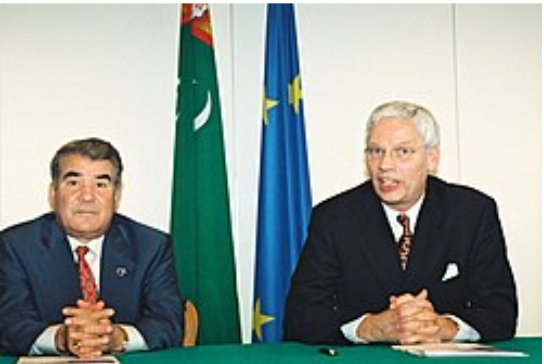
Neutrality as foreign-policy identity and political shield:
Permanent neutrality became Turkmenistan’s core foreign-policy brand. The UN General Assembly resolution of December 1995 gave neutrality international visibility and legitimacy (United Nations General Assembly 1995). In a region shaped by Russian influence, proximity to Iran, and changing security issues in Central Asia, neutrality offered a way to avoid deep alignment and to limit external demands. It also allowed selective cooperation when it served state interests.
Neutrality was not only a diplomatic position. It also worked as a domestic narrative. When a state claims a special neutral identity, it often links that claim to sovereignty and non-interference. The message is that internal unity is necessary because the country must remain protected from outside pressure. In a closed political environment, this can justify tighter control over civil society and information, because openness can be framed as vulnerability. This logic is visible in rights reporting from the period, which describes a state that “controls virtually all aspects of civic life” and isolates the country from outside influence (Human Rights Watch 2005).
To support that narrative, the regime invested heavily in symbolic politics. The most famous example is the Neutrality Monument in Ashgabat, which turned a foreign-policy doctrine into a visible and daily reminder of state identity. Even when readers do not know the details of policy, monuments can teach the intended national story. They signal permanence, authority, and a unified interpretation of history.

Ideology as governance: the Ruhnama:
Another central element of the regime was ideological governance through Rukhnama, a text attributed to Niyazov and promoted as a moral and national guide. Encyclopaedia Britannica notes that it became required reading in all schools and even formed part of driver’s exams (Encyclopaedia Britannica). This detail is important because it shows how ideology entered routine life. The message was not only displayed on billboards; it was inserted into education, certification, and employment pathways.
This approach creates a specific kind of social control. When a state makes an official narrative necessary for everyday success, it reduces space for alternative viewpoints without always needing open violence. People adapt because the incentives are clear. The state also gains a method of filtering and disciplining its own bureaucracy. If new officials must demonstrate familiarity with the official doctrine, loyalty becomes measurable. In this sense, the Ruhnama was not just propaganda; it functioned as governance by setting the conditions for belonging and advancement.
For International Relations students, there is another layer. A strong internal ideology can shape external messaging. It supports claims of national uniqueness and “special paths.” That can reduce external leverage. When outsiders criticize the regime, the leadership can answer that foreign norms do not apply to Turkmen national identity. Neutrality then reinforces that argument: the country is neutral, sovereign, and therefore not open to outside political judgment.

Renaming time and rewriting the everyday:
Niyazov’s symbolic policies also targeted language and daily reference points. Britannica notes that he renamed “days of the week” and “months of the year,” among many other objects and places (Encyclopedia Britannica). A calendar is normally treated as neutral. It is shared by all citizens, and it structures work, school, and administration. Renaming it therefore communicates a strong political message: sovereignty is not only about borders or diplomacy but about who defines normality. Each time the new month name is spoken, the state’s authority is repeated in everyday life. This is not “irrational” politics. It is a method of producing an environment where the leader’s capacity seems unlimited. In closed systems, such measures also face fewer public checks. Human Rights Watch described Turkmenistan under Niyazov as crushing independent thought and controlling civic life (Human Rights Watch 2005). In such settings, symbolic interventions can be implemented quickly and broadly because the channels for public challenge are weak.
Monumental Ashgabat and the politics of image:
Ashgabat became a central stage for the regime’s politics of image. Monumental urban projects can serve several goals at the same time. They present modernity. They create visible “achievements.” They also distribute resources in ways that reward loyal networks. In personalized regimes, large prestige projects often strengthen elite cohesion because they connect economic gain to political loyalty. These aesthetics also communicate externally. A capital presented as orderly and grand can signal state capacity to foreign visitors and investors. Yet the same image can hide social costs and political repression. This gap between presentation and reality is not unusual in world politics. It appears in many resource-rich states where international engagement is selective and domestic space is tightly managed. Turkmenistan’s neutrality narrative made that selectivity easier because it framed limited openness as a legitimate sovereign choice rather than an absence of freedom.
Why it matters today in International Relations:
Niyazov’s period remains relevant because it shows how international recognition can be used as a resource. The UN neutrality resolution gave Turkmenistan a formal diplomatic identity (United Nations General Assembly 1995). That identity then supported a broader political strategy: non-alignment abroad, strong control at home. It also helps explain why external pressure often has limited effect. When a state’s strategic value is tied to energy and geography, partners may prioritize access and stability over political reform. At the same time, rights organizations can document abuses without being able to change the basic incentives of engagement (Human Rights Watch 2005).
Conclusion
Niyazov’s Turkmenistan is best understood as a coherent political system rather than a collection of unusual decisions. Institutionally, the move toward president-for-life status concentrated power and reduced the possibility of alternation, shaping elite incentives around loyalty rather than accountability (Freedom House 1999). In foreign policy, permanent neutrality offered a recognizable identity and a protective framework against alignment pressures, reinforced by UN recognition in 1995 (United Nations General Assembly 1995).
Domestically, ideology and spectacle supported control. The Ruhnama entered schools and even driver’s exams, showing how state narratives can become administrative tools (Encyclopaedia Britannica). Symbolic interventions such as renaming the calendar signaled that the regime could reshape everyday reality. Monumental spaces in Ashgabat made the political narrative visible and repetitive. In combination, these elements created a model of sovereignty performed as spectacle, where external recognition and internal closure reinforced each other. Rights reporting from the period underlines the cost of that model for civic life and freedom (Human Rights Watch 2005).
Bibliography:
BBC News (2008) Turkmen go back to old calendar. Available at: http://news.bbc.co.uk/2/hi/asia-pacific/7365346.stm
Britannica, The Editors of Encyclopaedia (2024) Saparmurat Niyazov President of Turkmenistan. Available at: https://www.britannica.com/biography/Saparmurad-Niyazov
Human Rights Watch (2005) Turkmenistan: Events of 2004. Available at: https://www.hrw.org/news/2004/05/14/turkmenistan-human-rights-update
United Nations General Assembly (1995) Resolution 50/80: Maintenance of international security. Available at: https://docs.un.org/fr/A/RES/50/80
Ce dictateur a vraiment existé et on dirait une blague (november 19th 2023) Available at:


Comments