


Kherson: a War With No End in Sight
Updated: Mar 23
Occupation of 2022: general introduction
The 2022 war in Ukraine caught millions off guard. On 24 February, chaos erupted across the country. People responded in different ways: some immediately packed their belongings and fled, others stayed home, uncertain of what awaited them beyond their doors, and still others were powerless, trapped under occupation by Russian forces from the very first hours. This article tells the story of the first region to be occupied, which endured the fear and devastation brought by the invading army. This is the story of the Kherson region.
If you look at the map, it becomes immediately apparent why events unfolded the way they did. The Kherson region lies adjacent to the Crimean Peninsula, a territory that has been under Russian control since its annexation in 2014. Although the full-scale invasion of Ukraine in 2022 struck the world by surprise, there were, in fact, signs of what was to come. Weeks before the attack, Russian military equipment — tanks, armored vehicles, artillery, and missile systems — were transported from Siberia and the Far East to Crimea and the borders of Ukraine, as reported by «Крим.Реалії», a Crimea-focused outlet of the Ukrainian Service of «Радіо Свобода». The article, published on 12 January 2022, appeared 43 days before the Russian Federation initiated its offensive. Yet, despite having access to this crucial information and numerous other sources confirming Putin’s intentions, the Ukrainian authorities chose not to intervene in a decisive manner. This inaction would have profound consequences: it facilitated the swift occupation of regions such as Kherson and Zaporizhzhia and paved the way for the subsequent takeover of Donetsk and Luhansk. What precisely triggered the rapid movement of Russian forces from Crimea remains unclear.

The Kherson region borders Crimea, a peninsula that has been under Russian control since 2014. At first glance, the narrow Chonhar Strait and the bridges spanning it might seem to be an almost insurmountable obstacle — if only the defenses had been properly organized. Yet events unfolded differently. The bridges at Chonhar were not destroyed, the land passages were cleared, and Russian troops and equipment surged rapidly deep into the region. Mined fields, concrete barriers, dragon’s teeth — nothing could halt their advance. Why did this happen? There are many theories: betrayal, sabotage, official negligence, or basic mistakes in organizing the defense. The truth remains unclear. The enemy’s strength was overwhelming. According to Ukrainian generals, Russian forces on the southern front outnumbered Ukrainian troops by twenty to twenty-five times, equipped with artillery, aviation, and naval assets, while suppressing minefields and radio communications. Over 140 aircraft, 60 helicopters, and ships of the Black Sea Fleet moved at lightning speed. It is little wonder that Ukrainian units were forced to retreat. Even had the bridges been destroyed, the enemy’s capabilities were such that it would likely have made little difference. And yet, the questions linger. Why weren’t the bridges blown up in time? Who bears responsibility? The General Staff and military command maintain that preparations were made, but that the opposing forces were simply disproportionate. And the public continues to debate: who, in the end, ‘surrendered the south’?
Due to the rapid Russian advance, more than 300 Ukrainian servicemen were captured on the very first day of hostilities, according to the International Institute of Human Rights — a striking indication of just how swiftly and effectively the enemy’s initial offensive unfolded.
As a result, the enemy deployed assault aircraft, seized complete control of the skies, and enjoyed a fifteenfold advantage on the ground. There were also betrayals: the occupiers seemed to know the precise locations of minefields and the positions of Ukrainian troops.
By the afternoon of 24 February, Russian forces had reached Heniches'k and Nova Kakhovka, seizing the Kakhovka Dam and the crossings over the North Crimean Canal. They landed troops on the outskirts of Kherson, near Oleshky, and launched an assault on the Antonovsky Bridge, a vital route being used to evacuate military personnel and equipment.
On 1 March 2022, Russian forces took complete control of the city of Kherson.

From that day on, a shadow of unimaginable terror hung over the entire region, over every town and village. On the very day Kherson fell completely under enemy control, a fierce battle erupted in Buzkovyi Park, situated in one part of the city, between the territorial defence forces of Kherson and advancing Russian troops. According to a serviceman of the 34th Separate Coastal Defense Brigade of the 30th Marine Corps of the Ukrainian Navy, known by the callsign “Ostryi”, the fight lasted forty minutes. The Ukrainian defenders were armed with automatic weapons, grenades, and Molotov cocktails, while Russian forces brought armoured vehicles into the park — BTRs and BMPs — firing relentlessly on the soldiers hiding behind trees. According to the newspaper «Суспільне (Херсон)», fourteen Ukrainian soldiers were killed in Buzkovyi Park alone, with at least five more falling in other parts of the city, including Bilozerska Square. Oleksandr Prokudin, head of the Kherson Regional Military Administration, later reported that twenty-four territorial defence fighters were executed by the occupiers at point-blank range, with large-calibre machine guns and cannons. “Later, the brave townspeople organised the burials themselves and erected a cross on the trunk of a broken tree,” he said. And yet, this was not the end — it was only the beginning of the bloodshed that continues to echo through the region.
Personal experience: economic challenges, crisis of life stability
My own experience was far from pleasant. We did not live in Kherson itself, but in a village about twenty kilometers away, and at the time, we told ourselves, “Things aren’t so bad for us.” But that was far from the truth. The first months were marked by hunger and economic collapse. Bank cards stopped working on the very first day, but that was only half the problem — there was simply no food. Every morning, a truck delivered grain to our village, yet it was never enough, and prices soared fivefold. Adults had to wake at dawn just to scavenge a scrap of food, or else we would have to face a day without any sustenance at all. Meat, bread, sugar — these existed only in our dreams.
We were fortunate in one respect: the village’s location. Perched on a hill above Kherson, with the branches of the Dnieper River below, it offered some advantage. Soon, the men began fishing, not for leisure, but to feed themselves and others. Neighbors shared their catch, and this is how we survived until June. Yet, we were forced to eat fish every day — a taste I will never forget. The fish cutlets were disgusting, falling apart in your hands, smelling of swamp, tasting of rot. Often, it seemed easier to go hungry than to eat them.

Hunger was not the only concern. Russian soldiers periodically arrived in the village. They went house to house, searched belongings, interrogated people, checked phones — and if they were drunk, God only knows what could happen. Most often, men were taken, but women were not spared. Power cuts, communication blackouts, and internet shutdowns added to the constant pressure. Russian forces deployed special vehicles that jammed mobile communications, cutting us off from the world entirely.
Many might wonder: why didn’t we leave when we had the chance? Indeed, thousands fled the occupied region through the neighboring Mykolaiv region, seeking Ukrainian-controlled territory. But it was not due to any official “green corridor”; it was simply a human choice. Most of the route ran through open fields, and as night fell, people slept in those fields — and that was where the real hell began: airstrikes, artillery fire, cars colliding in the chaos, hitting hidden mines, exploding. Leaving was a deadly gamble — a Russian roulette: survive or perish.
After months under occupation, life assumed a cruel routine — a Groundhog Day of fear and survival. Humans adapt in strange ways. Constant explosions and rocket strikes became normal. By the fourth or fifth month, people no longer hid in basements at every sound of a flying missile. Did that mean we were no longer afraid? Not at all. We were simply exhausted, burned out, unwilling to care. False hopes were fed by promises from the Ukrainian side: “In two or three weeks, the battle for the south will begin.” By June, these were empty words; August came, and they faded to memory. Hope, the most precious thing, had been eroded.
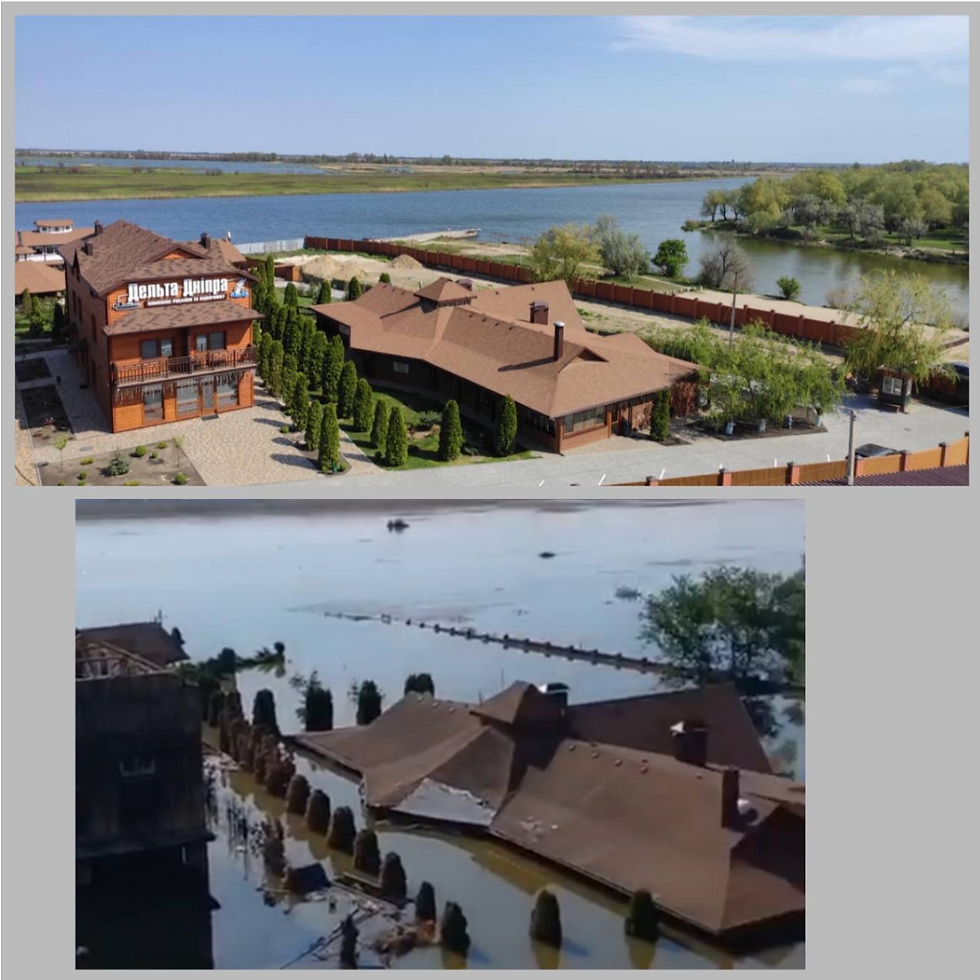
September and October passed, and the only news was Russia’s repeated threats to blow up the Kakhovka Dam — which they did less than a year later, on 6 June 2023, flooding 14 settlements on each bank of the Dnieper. And yet even that was not the end, merely another ordinary day in the long, tragic history of the Kherson region.
How it all ‘ended’ on November 11, 2022
The beginning of the end of the occupation was still nowhere in sight in the early days of November 2022. Around that time, however, the first signs began to emerge that the territory might soon return to Ukrainian control. Yet these changes came hand in hand with new hardships. On 4 November, both gas and water disappeared entirely; just two days later, electricity was gone as well. Combined with the ongoing explosions, it felt as though something terrible was looming. The power outage reignited the struggle for food, as refrigerators, which had preserved at least a portion of supplies, thawed, while the cold weather outside meant indoor temperatures barely reached 11 degrees. Perhaps the clearest sign of change was that Russian soldiers had completely abandoned all checkpoints. In Kherson itself, they had all but vanished.
November 11 is celebrated as Indepndence Day in Poland, and in the Right Bank of the Kherson region, this day became a celebration of long-awaited freedom. After the arrival of Ukrainian soldiers, people poured into the streets. Everyone rejoiced, hanging Ukrainian flags and sharing in the simple joy of liberation. Many truly believed that the nightmare was over. But how mistaken they were — unaware that hell was far from behind them.
On 20 November 2022, a Russian shell landed just thirty metres from my house — the shelling had begun from the left bank of the Dnieper. From that day onward, the fighting has never ceased. Entire neighborhoods were destroyed, homes burned to the ground, and countless lives were lost. The challenge of this battle lies in the Kherson region’s coastal division: with the river splitting the area, once positions are established on both banks, mounting a counterattack becomes nearly impossible. The fighting has dragged on for over three years, with little progress. People on the left bank remain under Russian occupation, while those on the right bank struggle to survive under constant shelling.

What was next? How the end of the occupation period emerged into a worse scenario: words of the witnesses.
Two people who survived the difficult times of occupation and the post-occupation period in the Kherson region agreed to give interviews in which they spoke sincerely and in detail about their experiences. Both interviewees asked to remain anonymous for reasons of personal privacy.
The first interviewee talked about how she lived through the occupation, specifically the period from 24 February to 11 November.
– What thoughts and feelings did you have in the first hours and days after the full-scale war began?
– Let's just say that we were mentally prepared for the start of this war because on the eve of the 23rd, we received information that the checkpoint to Crimea had been closed, and we were very close to Crimea and understood that the offensive would come from there. My husband didn't sleep all night, watching the
webcam at the Kalanchak checkpoint. Early in the morning, he woke me up and said, ‘It's started.’ He quickly drove to the petrol station to fill up the car so that we could evacuate in case of danger. When he returned, we soon heard whistling and a terrible rumbling. Then there were more whistles and rumblings. People began to rush out into the street. We looked in the direction of the rumbling and saw huge black mushrooms — these were explosions at the Chernobaivka airfield in Kherson. That's how the war began: confusion, incomprehension. There was no panic — there was incomprehension, because the day before, the authorities had stubbornly refused to acknowledge the possibility of an attack and had not prepared citizens for what to do in an emergency. Therefore, we understood that we had to rely only on ourselves. And in order to rely on ourselves, we needed information about the situation: what was happening, where it was dangerous, where we couldn't go, especially with a child. There was no information. Everything on television was vague. The president did not speak, the local authorities did not speak. There were no authorities at all.
– Was there a moment when you felt that the southern part had been surrendered?
– At first, I felt that the whole country had been abandoned. Left to fend for itself. There was a very good organisation where there were patriotic leaders — mayors of cities, mayors of villages — everything was organised there: immediate evacuation of children and women, organisation of life in the settlement, delivery of food, because at such a moment, medicines, food from shops and transport disappear. Since we were very close to the line where the enemy had entered, the local authorities, who were probably aware of this earlier, disappeared. They were simply not there. In our village, there was a village head, a woman, so it was difficult for her. The men organised themselves and decided to restore order, control, stand guard and help. Local entrepreneurs tried to organise the delivery of food that was available at the time. In general, everything fell on the shoulders of the population; there was no authority at all. As for whether the southern part was surrendered, it was surrendered from the very beginning because the authorities fled, and there was no defence. On the very first day, Ukrainian soldiers arrived in our village and simply asked for help. They had no food and no money for fuel for their vehicles. And I realised that not only the population had been abandoned, but also the military. Of course, everything had been surrendered and abandoned. Overall, I had a very clear understanding that something was going wrong in the country. The extremely criminal, incompetent, to say the least, criminal government, headed by an absolutely incompetent, and possibly even criminal leader, completely ignored the calls of the opposition and public organisations to strengthen defences at the end of 2021 and beginning of 2022. And this is what we saw in the south: no additional defence lines were equipped, no trenches were dug, no dugouts were built, and the creation of territorial defence was ignored. Our fellow villager was appointed head of the local district defence, but they completely put a spoke in his wheel. At first, they did not allocate premises where people who wanted to join the defence forces could gather. There was absolutely no cooperation, but most importantly, they did not even issue weapons when it was already clear that the enemy was advancing. And such facts, as the situation later showed, were everywhere. In other words, it wasn't just the South that surrendered. They probably wanted to surrender the whole country. But in the south, it was very obvious because the enemy covered a very long distance in a matter of hours with virtually no resistance. At the same time, when they advanced, they did not stand in ceremony with civilians who happened to be on the road at that moment and were not prepared to encounter tanks and other military equipment. There were instances when soldiers of the occupying army drove armored personnel carriers over civilian vehicles with people still inside. And I really wanted people to know about this.
– Can you recall the moment when it became clear that the situation was critical and there might be no way out?
– I remember very well that feeling of horror when we were abandoned in the early days, and food disappeared, medicines disappeared, and information about how to live on disappeared. Of course, it was very scary because we had not long moved to the Kherson region, and since we had just built a new house, we had no vegetable garden and no supplies. We faced a terrible problem — a lack of food. During the first month, we each lost up to 10 kilograms — both my husband and I. Even though we were already quite slim to begin with. Against the backdrop of terrible stress and not understanding what was happening, what to do, how to make the right decisions so as not to put our loved ones and child at risk, it was very difficult. My mother, who needed daily medication, was living with us. It was unclear how to do everything correctly and where to get the medication. People just shared and helped each other. Perhaps this helped us to hold on and not fall into despair.
– Did you ever think about the possible liberation of the region?
– The thought occurred to us sometime in the summer, when Ukraine received more serious weapons — HIMARS rockets — and began to use them. Then we realised that something could change for the better. We rejoiced at every strike against our hated enemy. It was announced that an offensive would soon be launched. Then there was a manoeuvre and the Kharkiv region was liberated, which made us indescribably happy because we understood the situation our fellow citizens were in. We believed that we might be next. In the spring and early summer, we simply closed ourselves off, lived our parallel lives, helped each other as best we could, and supported each other as ordinary citizens.
– How did you imagine the future of the Kherson region after that?
– I clearly understood that the Kherson region was divided by the Dnieper River, and I immediately said: If there is liberation and the Armed Forces of Ukraine cross the river, then we have a chance. But if everything stopped on the banks of the Dnieper, we would have to leave the territory immediately; otherwise, we would find ourselves on the front line, which is what happened. We were forced to flee. We lost everything — our property, our hope. And now we are more abandoned than at the beginning of the war. Finding ourselves deep in the country, we do not feel the support of the government, the president — call it what you will. We see that we are deeply alone: back then, we were close and supported each other, but now we are abandoned, scattered, and everyone is surviving as best they can. The state does not help in any way except by lying. We were promised compensation for the loss of our homes. Our homes in Kherson were valued at pennies — we cannot buy anything with that money. And even that is all in theory; they don't even give us that. And the slave-like situation is that if they give us virtual money, with which we can buy some small room, we have no right to sell or lose it for five years. They have made us slaves for five years, tied to a territory that may also become a target for shelling. They don't give us money, and they don't give us freedom.
The second interviewee shared his experiences of life after the liberation of the right bank of the Dnieper River, beginning on 11 November 2022.
– What were the first weeks after the liberation of the region like?
– The first weeks after the liberation of the region... were not weeks, but rather the first days, and were received with great joy by the population of the Kherson region, the Right Bank. Everyone came out and expressed their solidarity with the Armed Forces of Ukraine, their joy at the liberation.
– Did people feel more hopeful about the restoration of peaceful life or, on the contrary, confused and uncertain?
– People felt very hopeful that everything would be fine, everything would be restored, and life would return to normal. The first few days were perceived very, very positively. Everyone believed that this was the end and that the liberation of the right bank of the Kherson region would be followed by the liberation of the left bank. At first — for the first few days, 3–5 days — there was complete joy. That's how it was.
– What was a typical day like after liberation?
– A typical day after liberation, that is, the first 3-5 days, seemed very positive, very good. In our small village of Dniprovs’ke, as in Bilozerka, our armed forces, the Armed Forces of Ukraine, came in, and there were many people, soldiers, guys we knew — our acquaintances, our friends.
– What difficulties did you face on a daily basis?
– There were no difficulties. All the difficulties were during the occupation: supply problems, pressure from the Russian military, and checkpoints. And here, everything seems to be returning to normal. Ukrainian flags were raised in the village of Dniprovs’ke and the settlement of Bilozerka. We are liberated. Our authorities began to arrive and try to restore normal life. Everything was fine for the first few days. The first days were very, very good. There were high hopes and great joy.
– Was humanitarian aid organised for the local population? If so, what kind of aid was provided?
– From the very first days, humanitarian aid was provided in the form of food parcels, hygiene kits, advisory and legal assistance, and consultations on various issues. Local authorities began to work at the level of village councils and district councils. People were not abandoned; there was a sense that Ukrainian authority was returning to its territory and that local authorities were beginning to function. Everything was fine, and there was hope that everything would continue to be fine.
– If you had to choose between staying under occupation or living in a liberated but difficult post-conflict reality, what would you choose and why?
– That's a very difficult question, and it's very personal. Staying under occupation, in my personal case... is not an option. In 2014–2015, we lived under occupation. Life was quite comfortable, measured, without problems, but we made a choice and left, leaving the occupied territory, the Republic of Crimea, and moving to the Kherson region. In 2022, the same question arose: should we stay under occupation? The Kherson region, its right bank, was under occupation until 11 November 2022. We did not leave; we stayed to live under occupation, even though we had the opportunity to leave. Why? Because we no longer had the strength or the means to leave our homes. We were not at an age that would allow us to start a new life in the free territory of Ukraine. Did we believe in liberation or not? Some did, some didn't. Speaking for myself, I assumed that we might remain under occupation. And if liberation had not happened, we would most likely have stayed this time, because we have neither the strength, nor the means, nor the health, nor the age, when you are already approaching sixty, a new life is no longer an option. But everything changed after liberation.
– Was there a moment when you realised that the horrors of the conflict were continuing? What events or circumstances particularly reinforced this feeling?
– There were moments like that, of course. The first such moments were literally 4–5 days after liberation, when shells began to fall on our village for the first time. The left bank began shelling the right bank: the right bank had been liberated, the Russian army had retreated to the left bank, the Ukrainian army was on the right bank, and mutual artillery duels began. Heavy shelling began on our village of Dniprovs’ke. The local military said that we had to leave because it would be very scary and everything would be destroyed. We were still dismissive: ‘No, probably not.’ But on the fourth or fifth day, very heavy shelling began, and it continues to this day — it's been three years now. I realised what was happening a month later, when the shells started hitting not the house opposite, 20-40 metres away, but our yard. That's when you realise that yes, it's happening. And so it happened that a month later, we were forced to leave this house because everything was being destroyed.
Post-occupation personal experience: adaptation, psychological traumas.
Everyone experiences stress, trauma, and loss differently, even though we all share emotions such as sadness, grief, depression, and a sense of helplessness. My experience, like that of others, was distinct, shaped by its own trials and obstacles. After a prolonged period of self-isolation — days passing without speaking a word, sitting in my room doing nothing — the first challenge I faced upon returning to normal life was something as simple as ordinary social interaction. I found it impossible to communicate with people.
This was not the introverted reluctance to engage in that experience. It was far more complex. I was afraid to meet anyone’s gaze, I saw enemies in every face, and I could trust no one. Even after nearly two years, fitting into university life — a world that demands interaction — remained incredibly difficult.
Psychological trauma accompanied all of this. Insomnia took hold, born from the fear of being jolted awake by the sound of another rocket; PTSD manifested in flashbacks, panic attacks, and suffocating fear; loud noises, whether a tram passing by or a cupboard door slamming shut, triggered instant terror.
And yet, there is no true cure for the stress of war. No medication, sedative, or antidepressant can erase it. One must learn to live with the trauma; there is no other choice. Tens, perhaps hundreds of thousands, share my experience, but not everyone has the chance to speak out, and many do not even have the strength to do so.
Conclusion: moral of the story.
To this day, the left bank of the Kherson region remains under occupation by the Russian Federation, while the right bank has been left to fend for itself — at the mercy of those same Russian troops. People have been forsaken, rendered unwanted, and so they endure life on the front line, praying only to see the light of morning.
Many who once fled their homes will never be able to return: their houses have been destroyed — burned, demolished, flooded. And the most terrible thing is that, after all the horrors already endured, the blood of innocents continues to be spilled on this land even now. At this very moment, someone is sitting in a basement, listening to every sound, fearing that an enemy rocket or shell may strike at any second. At this very moment, someone is drawing their final breath beneath the rubble of what was once their home. At this very moment, someone has lost a loved one — and with them, their entire world.
And this is not a fictional tale — it is the real life of people just like you and me. People whose human rights are no different from ours. People who want nothing more than to live, not merely survive. This is the story of the Kherson region.

Bibliography
BBC News Ukraine (2023) ‘Who betrayed the South? BBC Ukraine uncovers details of the most high-profile investigation into the war with Russia.’ Available at:
Crimea.Realities (2022) ‘Russia is moving military equipment from Siberia and the Far East to Crimea and the Ukrainian border – CIT.’ Available at:
Dovgan, K. (2023) ‘4:50 AM: A Timeline of February 24, 2022 – What the Longest Day of Our Lives Was Like.’ Available at:
Ivantsiv, A. (2023) ‘For Kherson to the last. The story of the feat and death of the defenders of Buzkovyi Park.’ Available at:
MIHR (2023) ‘The first captives on February 24: how it happened. Stories of Ukrainian soldiers.’ Available at:
Moklyak, A. (2025) ‘"The forces were unequal." A fighter under the pseudonym "Ostryi" recalls the battle in Buzkovyi Park in Kherson SOCIAL | PEOPLE.’ Available at:
Moklyak, A. and Khlebus, O. (2024) ‘They went to Russian tanks with machine guns and "Molotov cocktails". The story of the defender under the pseudonym "Kherson".’ Available at:


Comments