


Nicolas Sarkozy, First French President in Prison
Updated: Mar 23

Nicolas Sarkozy is a French politician with a legal background as a lawyer. His legal career is linked to the company “Lagardère”, where he is now a member of the management committee. Alongside his professional life, Nicolas Sarkozy entered politics, initially within organisations such as the UJP (Union des jeunes pour le progrès) and later the RPR (Rassemblement pour la République). He then continued his political career by serving as a municipal councillor in Neuilly-sur-Seine.
In 1988, alongside Jacques Chirac for the presidential elections, he was elected as a député in the Hauts-de-Seine. After this, he was appointed Minister of the Budget under Balladur’s government; Minister of the Interior, Internal Security, and Local Liberties under Chirac’s government in 2002; and Minister of State, Economy, Finance and Industry in 2004. He left his functions in 2004 to become president of the political party UMP (Union pour un mouvement populaire). In 2005, he became Minister of State, Minister of the Interior and Spatial Planning, while remaining president of the UMP. He left the government in 2007 to prepare for the presidential elections, which he won. In 2012, he ran again but lost to François Hollande.
This article is published in reaction to the recent conviction of the former President in the Sarkozy–Gaddafi affair concerning the financing of his 2007 presidential campaign. He was convicted on 25 September 2025 by the Tribunal correctionnel de Paris for criminal association; the sentence included five years’ imprisonment, a €100,000 fine, and the suspension of his civil, civic, and family rights for five years. He was incarcerated on 21 October 2025 in the La Santé prison in Paris and released on 10 November under judicial control pending his appeal, which is scheduled for March 2026.
To understand the reasons behind this conviction, it is necessary to examine the origins of the affair, the context in which it unfolded, the individuals involved, its links to other cases, the views and decisions of the judiciary, and the role of the media, which played a key part. This article does not seek to incriminate former President Nicolas Sarkozy, in accordance with the presumption of innocence.
To understand this affair, we need to delve briefly into its historical background. Since 1969, Libya had been ruled by General Gaddafi and his inner circle. Despite Libya’s economic dependence on Europe, the regime pursued an aggressive policy towards the continent. It viewed Europe—and France in particular—as an obstacle to its African ambitions. Libya supported terrorist activities in Europe and sponsored attacks against airliners, such as the 1988 bombing of the Pan Am flight over Lockerbie, which killed 270 people, and the attack on UTA flight 772, which killed 170.
The United States responded with economic sanctions in 1982, followed by additional UN sanctions in 1992. In 1986, the US carried out a military raid on Tripoli, including a strike on Gaddafi’s palace. After this period, and especially following the attacks of 11 September 2001, Libya began shifting its policy: it handed over the suspects of the Pan Am bombing and compensated the victims of the UTA 772 attack in 2003. Diplomatically, this contributed to a warming of Franco-Libyan relations, marked notably by French President Jacques Chirac’s visit to Libya in November 2004.
Our story begins in 2005 and centres on two men: Claude Guéant and Ziad Takieddine. Mr Takieddine, a Franco-Lebanese businessman, acted as an intermediary in international arms contracts. He is presented by Mediapart and by the Paris Court of Appeal as the man who introduced Nicolas Sarkozy to the Gaddafi family. It is important to note, however, that Mr Takieddine is a complex and controversial figure: at one point he admitted to transferring €5 million to Mr Sarkozy, before later retracting this statement. Although the French judiciary recognises his role as an intermediary, it is impossible to establish definitively whether this sum—around €5 million—was used to finance the presidential campaign. He has never been tried in France in connection with this affair, as he went into exile in Lebanon, leading to an international arrest warrant being issued against him.
Claude Guéant, Nicolas Sarkozy’s right-hand man, served as chief of staff at the Ministry of the Interior and later became the director of Sarkozy’s 2007 presidential campaign.
From 30 September to 2 October 2005, Mr Guéant travelled to Libya—without an interpreter, bodyguard, or diplomat—conducting a discreet visit to Tripoli, the Libyan capital. This information emerged from Mr Takieddine’s files, revealed by Mediapart. These documents show that Mr Takieddine, acting as an intermediary, explicitly stated that the visit was to remain discreet and that neither the Élysée nor the Ministry of Foreign Affairs should be involved, as it concerned another important matter.
It is already questionable that the right-hand man of the Minister of the Interior travelled to Libya without informing the consular services, or even the French Embassy in Tripoli, of his arrival. Moreover, according to the prosecution, the “important matter” that Sarkozy’s entourage wished to keep secret was the plan to finance the future presidential campaign—not necessarily the act itself, but the intention to establish such a corruption pact.

The other crucial point concerns the person Mr Guerant is visiting in Libya. He meets with Abdallah Senoussi, a high-ranking official in the Libyan government and head of the intelligence services, who was prosecuted and found guilty of terrorism in connection with the UTA 772 bombing, the French airliner flying from Paris to Brazzaville. This terrorist attack resulted in 170 deaths, including 54 French citizens.
He defends himself by claiming ignorance of the background of Abdallah Senoussi and that this meeting was an ambush, even though the judgement and the international warrant had been issued six years earlier. He is part of the Ministry of the Interior, one of the most well-informed bodies, yet he failed to notify the French authorities afterwards and will meet with him later.
So here we have the right-hand man of the French Minister of the Interior furtively meeting with someone convicted of terrorism in France. This meeting took place without informing the French government, behind the back of the French embassy, and solely through Mr Takkiedine.


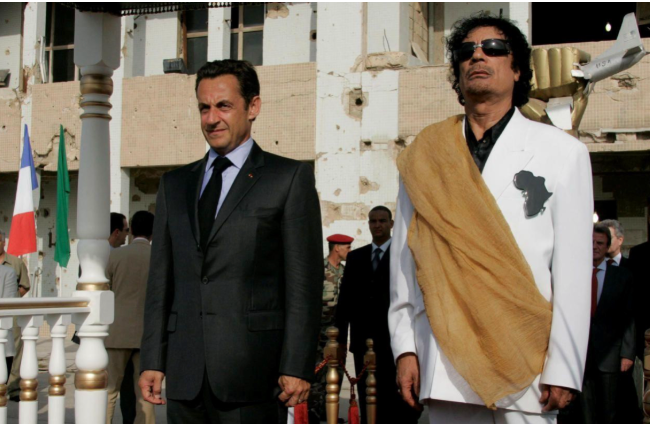
On October 6, 2005, it was Interior Minister Nicolas Sarkozy's turn to travel to Tripoli for an official visit to discuss migration and the fight against terrorism. This might seem rather inappropriate, even ironic, given the history of Muammar Gaddafi and Abdullah Senussi. Nicolas Sarkozy met with Muammar Gaddafi, and he later admitted in custody that during this meeting, Gaddafi's camp raised the issue of Abdullah Senussi's warrant. Indeed, the Libyan government wanted to improve its international image and no longer be associated with its reputation as a state supporting terrorists; it therefore wanted its head of intelligence services exonerated, or at least for the charges against him to be dropped.
This visit, according to the prosecution, signifies the fulfilment of a “corruption pact” and “criminal conspiracy,” whereby, in exchange for financing his presidential campaign, the French state could grant advantages to the Libyan government. It is alleged that one of these advantages would be to resolve the legal issue: the international arrest warrant against Abdallah Senoussi, which the president's camp is said to have sought to have overturned or to find a loophole in order to invalidate. This would allow Libya to re-emerge onto the international stage. And it is possible that Muammar Gaddafi saw in Nicolas Sarkozy the president who would allow him to realise his dreams of African unification, of which he would be the “king of kings”.
On November 24, 2005, Nicolas Sarkozy's personal lawyer and friend Thierry Herzog, who was convicted along with Sarkozy in the Bismuth wiretapping case in 2014 for active corruption and active influence peddling, travelled to Tripoli to meet with Abdallah Senoussi's lawyers and propose a plan to have the arrest warrant overturned.
Following this, in December 2005, Brice Hortefeux, Minister Delegate for Territorial Collectivities under the authority of the Ministry of the Interior and a close associate of Sarkozy, travelled to Libya and also met with Abdallah Senoussi, again without the presence of the diplomatic corps or bodyguards, and with only Mr. Takkiedine present. He himself acknowledges this meeting but refutes the prosecution's version, claiming that he provided bank details for making transfers and that he was only there to discuss migration with the Libyan official. It seems questionable to me that the Minister Delegate for Territorial Collectivities — the minister responsible for relations between the state and the various territorial entities — would travel to a foreign country to discuss migration when the Ministry of Foreign Affairs or the Ministry of the Interior exists. But perhaps this is simply the complexity of the French system that I am unable to understand…

Following this visit, €440,000 of Libyan money was sent in early 2006 to an offshore account belonging to Mr. Takkiedine, and then to Thierry Gaubert, a close associate of Nicolas Sarkozy who had worked at the Neuilly-sur-Seine town hall. A note about this transfer, written “NS campaign,” was found in his electronic notebook. However, he denies the accusation. He has not yet been tried by the French courts for the use of these funds in the presidential campaign. Nevertheless, the French justice system has already convicted him for money laundering and tax fraud in separate cases.
At the end of 2006, a document — a note from Moussa Koussa, the head of Libyan intelligence, addressed to Bachir Saleh, treasurer of the Libyan regime — revealed a promise of up to €50 million in funding for Sarkozy's campaign. This document was published by Mediapart in 2012.
In addition to this, in late 2006 and early 2007, the corrupt agent Mr. Takkiedine confessed to having handed over three suitcases of cash to Nicolas Sarkozy, in addition to wire transfers, totalling €5 million. This confession was made by Mr. Takkiedine himself in 2016. The president refuted this, but he was not able to discredit Mr. Takkiedine's accusations, as he had no alibi.
French authorities believe that significant sums of cash did indeed circulate during the presidential campaign. The key element is the substantial sum (€250,000) in cash. This €250,000 represents what remained after the campaign. When the campaign treasurer, Eric Woerth, was questioned, his justification was that these were anonymous donations that came by mail. This seems rather strange, especially since the bills were in large denominations (€200 and €500), and given that donations can be tax-deductible up to a certain amount, there was no logic in so many letters being anonymous, particularly since Nicolas Sarkozy was not a candidate from an extremist party. Furthermore, the mailroom director for Nicolas Sarkozy's party (the UMP) denies having seen these envelopes.
The other suspicious element comes from Claude Guéant, the director of Nicolas Sarkozy's presidential campaign, who, for the duration of the campaign, opened a vault. It was large enough for a person to stand upright inside. His justification was that he opened it to store speeches by Nicolas Sarkozy. The prosecution questions the usefulness of using a vault for speeches. It could be argued that he could have put them on a USB drive or stored the documents in a secure safe. The prosecution also questioned the necessity of storing speeches that would become public, given that they were intended to be released by Nicolas Sarkozy. The need for a vault is only useful when storing bulky items, which can only be physical objects like bags of cash. Obviously, this is only speculation, as there are no images or concrete information about what might have been stored in this vault.
In April 2007, following a presidential campaign whose suspicions we have detailed, Nicolas Sarkozy became the 23rd President of the Fifth French Republic. His five-year term saw Libya play a key role.
Bibliography
Blast,26.09.2025,Le jugement Sarkozy à lire et à télécharger,URL:https://www.blast-info.fr/articles/2025/le-jugement-sarkozy-a-lire-et-a-telech
Blast,23/03/2025,Xavier Monnier,Procès libyen : Un septennat de prison requis contre
Blast,le souffle de l’info,13/10/2025, TOUT COMPRENDRE SUR LE JUGEMENT ET
L’INCARCÉRATION DE NICOLAS SARKOZY,
Blast,le soufle de l’info,08/11/2022,QATAR / FRANCE : 300 MILLIONS POUR UNE
GUERRE EN LIBYE,08/11/2022
URL:https://youtu.be/aTsbeG42UGM?si=Zip0D6qYWq59Fd-w arger--BmT3bXXQC-y7JH3Ez9RuA
BFM TV, Takieddine,22/04/2013,Mathias Chaillot avec Jean-Jacques Bourdin, «La Libye a versé de l'argent à Guéant et Sarkozy»,URL:
https://www.bfmtv.com/politique/takieddine-la-libye-a-verse-de-l-argent-a-gueant-et-sarkozy_ AN-201304220088.html?utm_source=chatgpt.com
C l’hebo,26/09/2025 ,France Televison,Affaire du financement libyen : quand Cash investigation enquêtait sur le clan Sarkozy,
HugoDecrypte-Grands formats,12/01/2025,URL:https://youtu.be/PkI_Dgs5Y38?si=qXToCHLvmJ8gDide
imineo Documentaires,31/03/2017 ,Le président et le dictateur - Sarkozy & Kadhafi - Documentaire,URL: https://youtu.be/KrJ5k12ACf0?si=tpJC4ZEWqbB4x3sh
Investigation,26/09/2025, Sarkozy-Kadhafi:une histoire INTERDITE,


Comments